
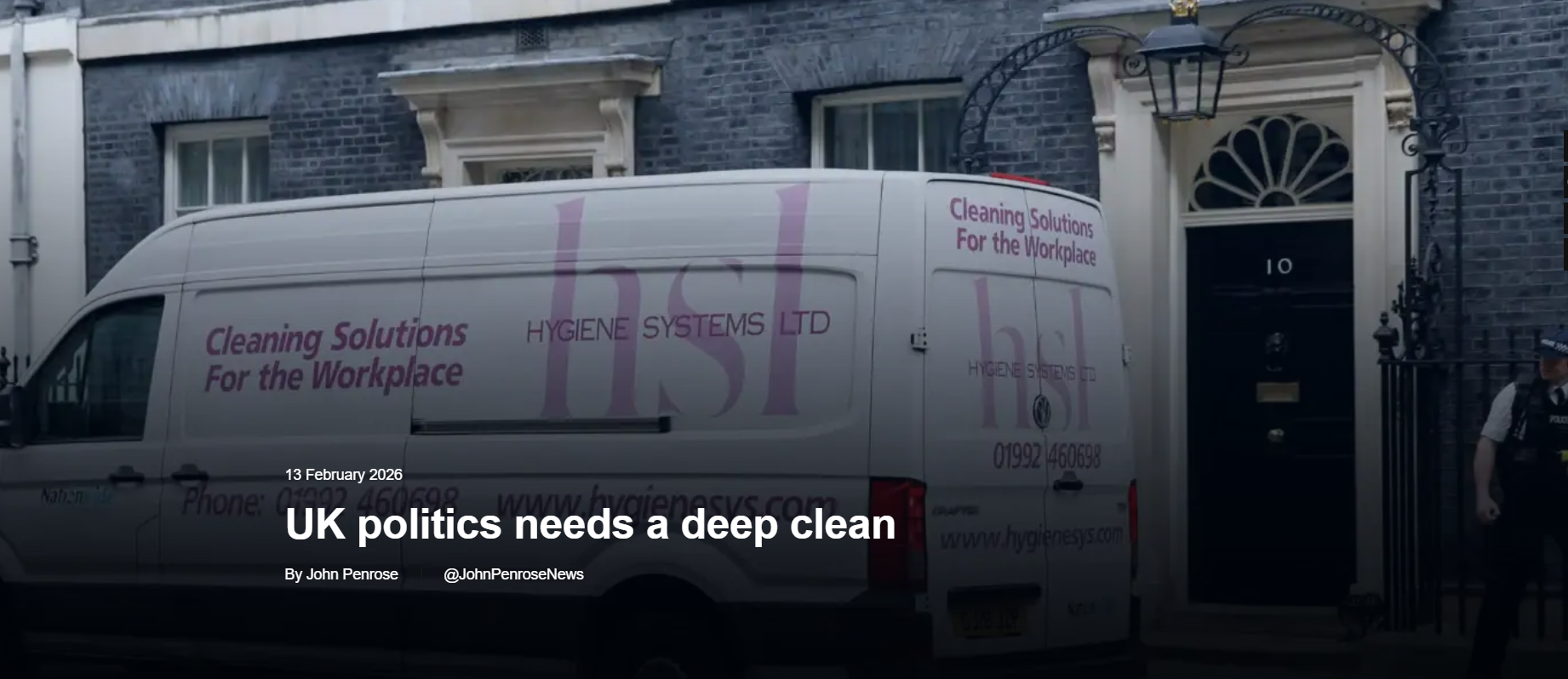
How times change. It was only last autumn when I outlined here in CapX how an already-sleazy new Government needed an integrity reset to clean up politics and save its own reputation at the same time. Now it is increasingly clear that we are facing a growing integrity crisis in UK politics – and the Government’s promised reforms may not be enough.
Last year, everyone thought scandals like donor-funded clothing and freebie tickets to Taylor Swift concerts or the footy were pretty bad.
But then the hole got deeper, as a steady drumbeat of disgrace fuelled resignations over everything from mistreating housing tenants to dodgy WhatsApp messages, forgetful tax returns and Peter Mandelson’s close friendship with paedophile financier Jeffrey Epstein.
And now it’s deeper still, with Parliament demanding to know what No.10 knew when the decision to appoint Mandelson as US ambassador was taken, and police investigating whether government secrets were illegally shared for Epstein to profit from. And to top it all, the latest Transparency International Corruption Perceptions Index shows Britain’s score – in decline since 2017 – has slipped another point, reinforcing concerns about corruption and declining standards in UK politics.
For a Prime Minister who isn’t just a former Director of Public Prosecutions, but who also came to power promising to ‘restore honesty and integrity to government’, it will have been a soul-destroying few months.
All the more reason, then, to expect the Government to pour a big bucket of extra-strong disinfectant all over Westminster and Whitehall in its long-promised integrity reforms. But, so far, the bucket looks too small and the disinfectant too weak to clean all the places it should.
Why Labour’s integrity reforms fall short
For example, the new rules to stop severance payments for Ministers who take plush jobs lobbying parts of government they were leading a few months before are welcome but too weak. They won’t stop anyone whose new job pays more than the severance they’re losing; they ought to cover senior political advisers as well as Ministers; and the equivalent rules for senior Whitehall mandarins aren’t always enforced properly either.
The transparency improvements which have been promised to show who has met Government Ministers and mandarins, and what was discussed, are essential and welcome. But they need to cover political advisers as well, and need to be searchable to ensure there’s no special treatment or access for people who’ve made political donations. And the same goes for the promised new rules controlling who sees secret Government briefings, so they can’t be shared for profit – as the police are investigating in the latest Mandelson case.
Equally, some rules on conflicts of interest look too narrow if they assume political favours are only done for profit. There are plenty of reasons why non-profits like charities, labour unions and religious bodies also want to bend the ears of Ministers, mandarins and advisers. Most will be fine but, inevitably, a few won’t. So assuming they are all pure as the driven snow just because there’s no profit involved is naïve and dangerous.
Political honours fuel charges of cronyism
Political honours should be included in the reforms and pared back sharply. Otherwise, every New Year and King’s Birthday Honours list will continue to attract accusations of cronyism. Such claims undermine what ought to be a joyful celebration of British achievement and public service. Instead of showing that our country is a genuinely fair and meritocratic aristocracy of talent, the current system reinforces the perception that we are a society where a gilded elite rewards its friends.
Last but not least, all these risks aren’t confined to Westminster and Whitehall either. Quangos, devolved governments and local councils are all vulnerable in one way or another, so any integrity reset needs to cover them thoroughly, rather than leaving reforms to an unspecified date that may never come.
If the Government is serious about tackling the integrity crisis in UK politics and restoring public trust, it will need more than symbolic reform. An integrity reset is still possible and, given this Government’s ever-growing list of scandals, it’s probably more important than ever. But this time, it will take an even bigger bucket of disinfectant to get the job done.
If you like this idea, you’ll find more details, soundbites and rebuttals about it under Integrity & Honours and An Aristocracy of Talent in the Policy Thumbnail section of our website
This article is the latest in a fortnightly series of policy proposals published in CapX from John Penrose and the Centre for Small State Conservatives.
Leave a Reply